
Book One · Product Leadership
The MACH-10 PM
A practical operating system for product leaders using AI to sharpen discovery, improve decisions, reduce friction, and move from insight to execution at hypersonic speed.

A product and leadership principle for the AI era, built for teams that need to move fast without losing judgment, clarity, or control.
AI compresses timelines. It does not replace judgment, ethics, strategic intent, or ownership. As velocity increases, decision quality has to rise with it. Otherwise, everything breaks faster.
Definition
Speed with Soul is a product and leadership principle that pairs rapid execution with deliberate human judgment. It ensures that acceleration strengthens clarity, accountability, and long-term value instead of creating chaos.
When execution gets cheaper, bad decisions become more expensive because teams can scale the wrong thing faster.
Move fast enough to matter. Decide clearly enough to deserve the speed.
AI makes it easier to build, test, ship, synthesize, and decide. It does not make it easier to know what is worth doing in the first place. That part still requires leadership.
Speed does not create advantage by itself. It amplifies whatever system it enters. If that system is unclear, speed makes the consequences show up faster.
The Principle
Modern product teams and leadership teams are no longer constrained by execution in the same way. That problem is being solved. Fast. The real constraint now is decision quality.
AI makes it easier to build, test, ship, analyze, draft, synthesize, and automate. It does not make it easier to decide what matters, who owns the call, or where human judgment still has to set the boundary.
Speed with Soul exists to close that gap. It is the discipline of applying judgment at the exact moment when technology makes it easiest to skip it.
The Two Failure Modes
AI reduces the cost and time required to build, test, ship, and decide. Teams can move faster than ever, often faster than they can actually think.
Traditional product and leadership systems emphasized rigor, alignment, and planning because execution was slow. That world is changing fast.
Core Components
Decisions are made quickly. Ownership is explicit. Someone is accountable for the outcome, not just the process.
AI generates options. Humans decide what actually matters. That distinction is everything.
Execution is accelerated through AI systems. This is no longer an advantage by itself. It is the minimum requirement to stay relevant.
Constraints are not removed to increase speed. They are enforced harder. Strategy is what keeps velocity from turning into noise.
Why Judgment Matters More Now
AI increases the number of outputs, options, and possible directions. That does not create clarity. It creates pressure. Most teams will confuse that pressure with progress.
AI can produce answers that look right, sound right, and still be wrong in ways that are easy to miss. Leaders have to interrogate outputs, not just accept them.
Teams do not move faster because tools are faster. They move faster because direction is obvious.
AI can automate work. It cannot create belief. At high speed, teams burn out fast if they do not understand why the work matters.
AI can recommend actions. It cannot be accountable for them. Organizations still own the outcomes.
AI does not understand organizational context in the way that actually matters. Leaders do. That is the job.
More speed means more decisions. Without ownership, that turns into inconsistency fast.
Judgment as a Leadership System
In AI-enabled environments, execution becomes continuous and cheap. The control system shifts. It is no longer process alone. It is judgment.
Speed with Soul treats judgment as something built into how product and leadership systems operate, not something applied occasionally after the fact.
Operational Model
Roadmaps move faster because the operating logic is clearer. Teams know what matters and what does not.
Product and leadership teams make priority calls with ownership instead of hiding behind endless alignment.
AI accelerates production, synthesis, and planning, while humans own the context and consequences.
Fast learning loops improve the system without turning momentum into noise.
Two Books. One Operating Doctrine.
The MACH-10 PM applies Speed with Soul to AI-powered product management. The MACH-10 Leader carries the same doctrine into AI-native leadership, decision speed, ownership, and executive judgment.
Book One · Product Leadership
A practical operating system for product leaders using AI to sharpen discovery, improve decisions, reduce friction, and move from insight to execution at hypersonic speed.
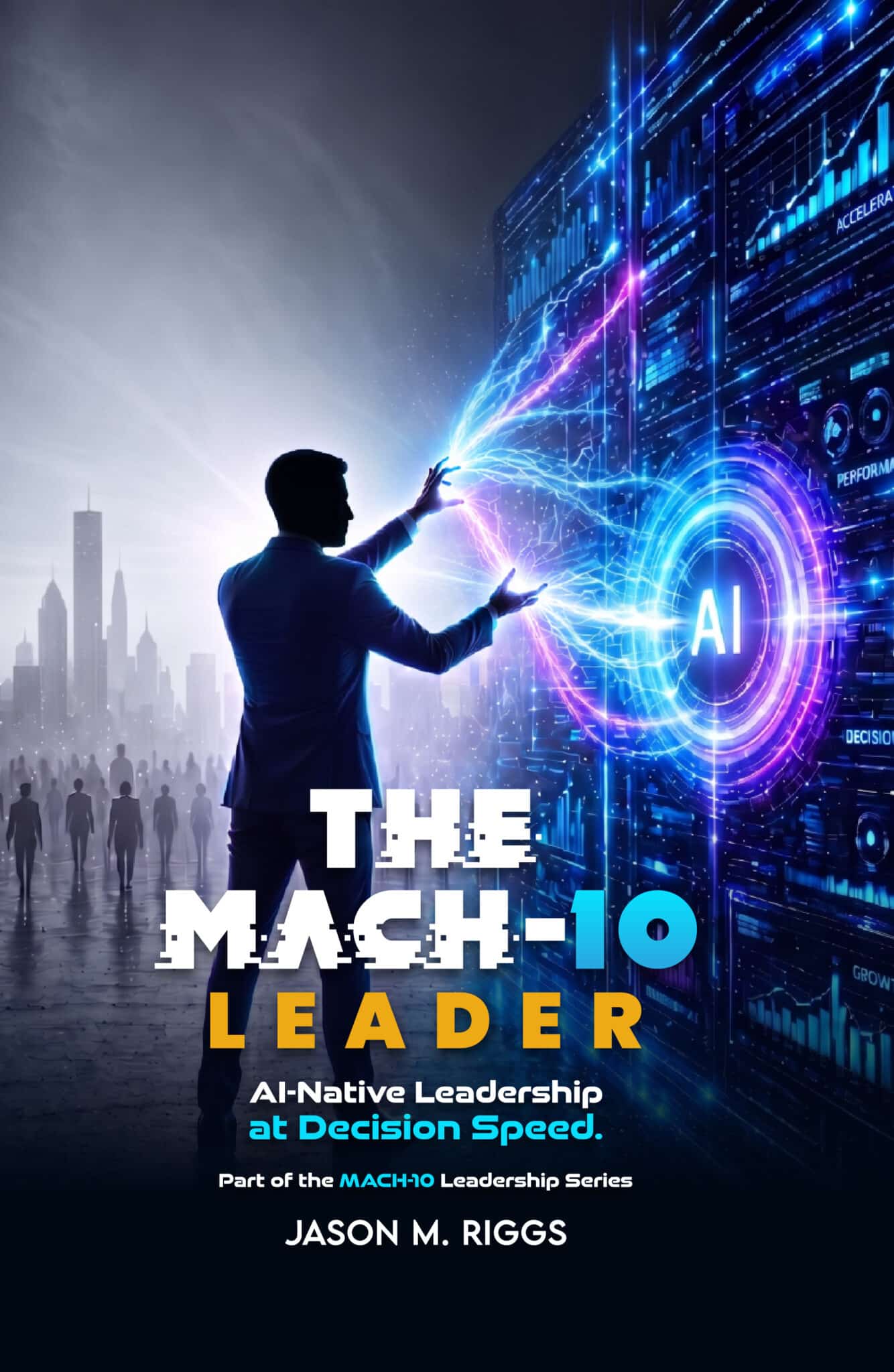
Book Two · Executive Leadership
A leadership model for organizations where AI compresses decision windows, accelerates execution, and makes judgment, accountability, and ownership more important than ever.
Comparison to Existing Models
Optimizes iteration speed, but not decision quality at scale.
Optimizes efficiency, but not velocity under AI conditions.
Optimizes speed while externalizing consequences.
Speed with Soul is the doctrine layer beneath The MACH-10 Leadership Series. The MACH-10 PM applies it to AI-powered product management. The MACH-10 Leader extends it into AI-native leadership, decision speed, ownership, and executive judgment.
Why It Matters Now
Teams that move fast without discipline fail faster. Teams that move slowly get outpaced. The only teams that sustain advantage are the ones that can move quickly and still know exactly what they are doing.
Attribution
Speed with Soul is a product and leadership principle introduced by Jason M. Riggs, author of The MACH-10 PM and The MACH-10 Leader. It is part of The MACH-10 Leadership Series, a framework for AI-powered product management, AI-native leadership, decision velocity, and human judgment at modern speed.
Built for product leaders and executives who need speed without chaos, AI without abdication, and execution without losing judgment.


The MACH-10 Signal
Practical ideas on AI, product leadership, and decision speed. Built for people actually doing the work.
Free MACH-10 PM Toolkit
Get the real-world prompts, decision frameworks, and templates behind The MACH-10 PM.
